
Closed by the Diocese, Reopened by Rome
The Vatican has its own rulebook for shutting a church — the reasons that don’t count, the steps that make a decree void, and the Lithuanian parish Rome ordered reopened.

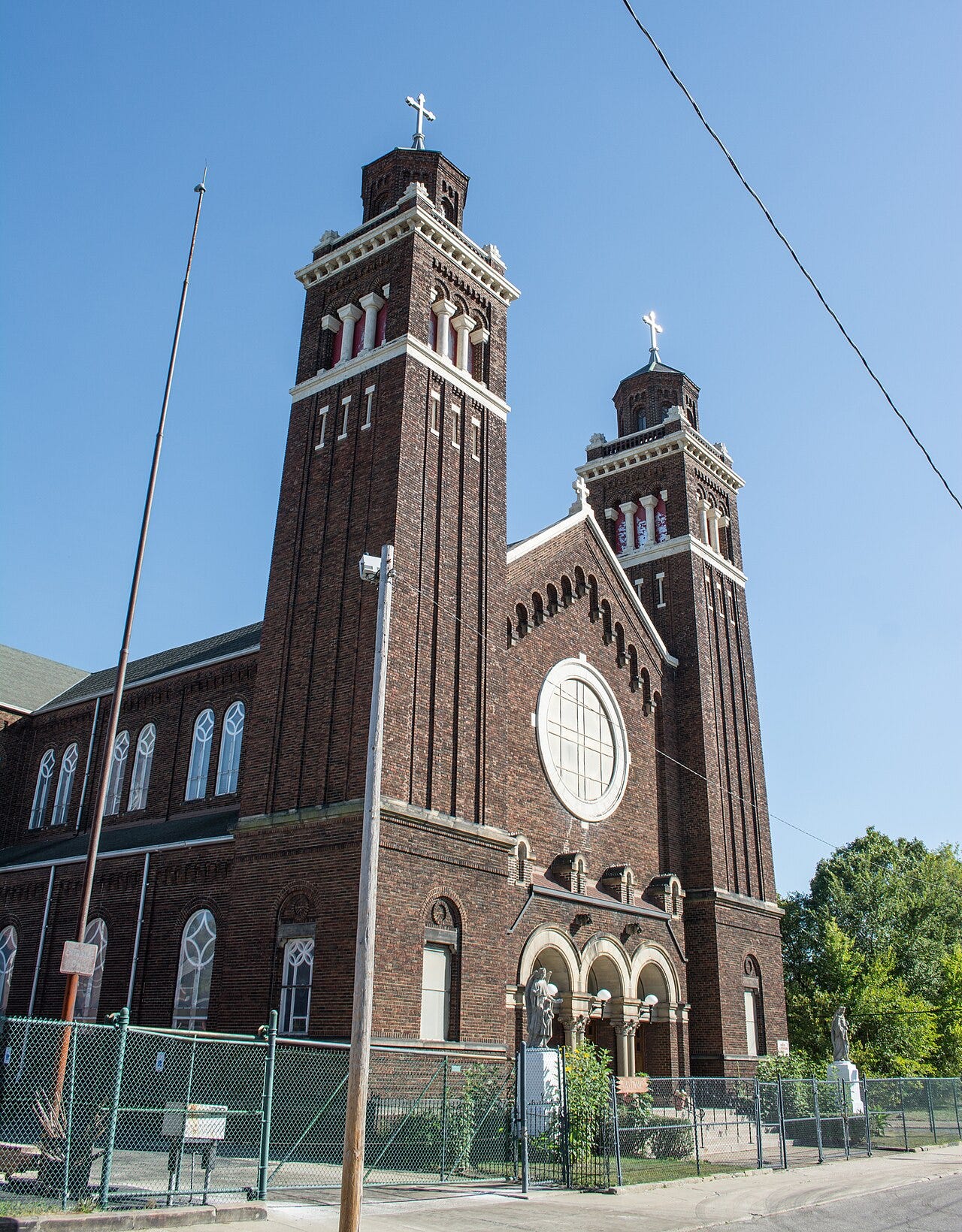
St. Casimir Lithuanian parish, Cleveland — closed by the diocese in 2009 and reopened by order of the Vatican in 2010. Photo: Tim Evanson, CC BY-SA 2.0.
When a diocese announces that a church will close, the announcement sounds like the end of the story. A decision has been made; the last Mass is scheduled; the community is thanked for its years of faithfulness. What almost nobody tells the parishioners standing in those pews is that under the Catholic Church’s own law, a closure done wrong is not a closure at all — and that Rome has said so, in writing, and ordered churches reopened.
This is not a loophole, and it is not rebellion. It is the Church’s own rulebook. Everything below comes from Vatican documents and the public record.
The document most parishioners never hear about
On 30 April 2013, the Congregation for the Clergy — the Vatican office with authority over parishes — sent every diocesan bishop a circular letter (Prot. N. 20131348, signed by its prefect, Cardinal Mauro Piacenza) enclosing a set of Procedural Guidelines for the Modification of Parishes and the Closure, Relegation and Alienation of Churches. The Guidelines were published, with the Congregation’s permission, in the canon law journal The Jurist (vol. 73, 2013), and they distill the rules Rome had already been applying in parishioner appeals.
The Guidelines’ first lesson is simple and powerful: merging a parish, closing a church building, and selling that building are three separate and distinct legal acts. Each has its own required procedure. Each requires its own written decree. A diocese cannot fold them into one announcement — and each decree can be challenged on its own terms.
That distinction matters enormously in practice, because a bishop’s authority over the parish (the community, as a legal entity) is much broader than his authority over the church (the consecrated building). Suppressing a parish does not automatically permit closing its church.
The seven reasons that don’t count
To permanently close a church — to withdraw it from sacred use — canon 1222 §2 of the Code of Canon Law requires a grave cause. And here the Guidelines say something most parishioners have never been told. Church jurisprudence has established that the following reasons, in themselves, do not constitute a grave cause:
A general diocesan plan to reduce the number of churches
That the church is “no longer needed”
That the parish has been suppressed
That the number of parishioners has decreased
That the closure “will not harm the good of souls”
A desire to promote parish unity
A potential future cause that has not yet happened
Read that list again. It is close to a complete catalogue of the reasons dioceses actually give when they close ethnic parishes: fewer people, a diocesan restructuring plan, the parish has been merged anyway. Rome’s own guidance says: not enough. And the Guidelines add a decisive detail — permanently closing a church, even without formally converting it to secular use, is legally equivalent to doing so. Absent a valid grave-cause process, the church must remain open.
(To be fair to the other side of the ledger: gravity can arise from a combination of causes, and temporary closure or reduced use of a church is permitted without this process. The protection is real, but it is a shield against permanent closure done casually — not against every hard decision.)
The procedural traps that invalidate a decree
Appeals to Rome are rarely won on sentiment. They are won on procedure. The Guidelines spell out requirements that go to the validity of a bishop’s decree — meaning that if they were skipped, the decree is not merely unfair; it is void:
Genuine consultation. Before modifying a parish or closing a church, the bishop must consult his Presbyteral Council — lawfully convoked, given all relevant information, and consulted on each individual parish or church, not on a diocese-wide plan in the abstract. This consultation is required for validity.
Specific reasons. The motivating cause must be ad rem — specific to that parish. Generalized, diocese-wide motivations alone cannot justify the modification of a specific parish.
The goods follow the people. When parishes are merged or divided, church jurisprudence is clear that the parish’s temporal goods — its property, funds, and patrimony — follow the faithful, and decrees must respect the intentions of founders and donors (canons 121–123). For communities like ours, whose churches were built with immigrant nickels and dimes, that is not a technicality. It is the legal memory of who paid for the roof.
Money last, not first. Financial need can support a closure only where it is demonstrated that other reasonable sources of funding were considered and found inadequate.
None of this is nostalgic special pleading. The Congregation for the Clergy’s 2020 Instruction on parish reform (The Pastoral Conversion of the Parish Community, nn. 48–50) reaffirmed the same framework: reasons must be directly and organically tied to the specific parish, and blanket reorganization decrees violate the norms. This is current law.
Cleveland: the proof that it works
If this all sounds theoretical, it has a date, a decree number, and a reopened church attached to it.
In 2009–2010 the Diocese of Cleveland carried out one of the largest downsizings in American Catholic history — contemporary reports put it at roughly fifty churches. Among them was St. Casimir, a Lithuanian parish on Cleveland’s east side. Bishop Richard Lennon presided at its final Mass on 8 November 2009.
The following Sunday, parishioners came back to the locked church and prayed outside. They returned the Sunday after that. They kept returning — through Cleveland winters — for 139 consecutive Sundays, about two years and eight months. And while they prayed, they also filed: a formal canonical appeal to the Congregation for the Clergy, arguing the closure had failed the very requirements above.
On 1 March 2012, the Congregation issued its decree (Prot. N. 20120457, signed by Cardinal Piacenza): the closing of St. Casimir was invalid, on procedural and substantive grounds. It was one of roughly a dozen Cleveland closures Rome reversed that month — reported at the time as 13 parishes, and described as the Congregation’s first mass reversal of diocesan closures in about two decades. The bishop chose not to appeal to the Church’s highest administrative court, the Apostolic Signatura. On 15 July 2012, St. Casimir reopened, with a thousand or more people at the Mass. It remains listed in the Diocese of Cleveland’s parish directory today.
Vigil and appeal. Presence and procedure. Neither alone reopened that church; together they did.
And one Lithuanian parish that never closed at all
Closer to the pattern we hope for: St. Peter Lithuanian parish in South Boston, founded 1896. When the Archdiocese of Boston’s 2004 reconfiguration put it under threat, parishioners organized the Friends of St. Peter Lithuanian Parish and raised a “Boston Hill of Crosses,” modeled on Šiauliai’s, as public prayer. The closure never came. In October 2024 the parish marked the 120th anniversary of its church (consecrated 1904), and as of this summer it still gathers for Sunday Mass in Lithuanian — sharing a pastor with neighboring parishes since 2015, which is an operational arrangement, not a closure. Organized, visible, faithful communities are simply harder to close.
What this means for our parishes
Honesty requires saying it plainly: appeals are the exception, not the rule, and many were lost — including by Lithuanian communities in our own record. The clock is also merciless: the window for challenging a decree is measured in days from its publication, not months, so a community that waits for certainty has usually already lost its standing. (Exact deadlines depend on the decree — this is the moment to engage a canon lawyer, not after.)
But the verified record supports a clear playbook, and every step of it is loyal to the Church:
Get the decree. Ask, in writing, for the written decree and its stated reasons. Three acts — parish, church, sale — mean up to three decrees.
Check the seven reasons. If the stated cause for closing the church is on the list above, say so — in your petition to the bishop and, if needed, to Rome.
Check the procedure. Was the Presbyteral Council genuinely consulted about your parish? Are the reasons specific to your church, or copied from a diocese-wide plan?
Follow the money and the donors. The goods follow the people, and donor intent binds. Ask where the patrimony your grandparents gave will go.
Stay present. Cleveland’s 139 Sundays were prayer, not protest against the Church — and Rome noticed.
File on time. Days, not months.
Standing up for a parish this way is not standing against the Church. It is asking the Church to follow its own law — the same position this movement takes on who owns a parish’s property. Alignment, not separation.
Sources
Congregation for the Clergy, circular letter Prot. N. 20131348 (30 April 2013) with Procedural Guidelines for the Modification of Parishes and the Closure, Relegation and Alienation of Churches, published in The Jurist 73 (2013) 211–219 — document PDF · Project MUSE
Congregation for the Clergy, Instruction The Pastoral Conversion of the Parish Community (2020), nn. 48–50
St. Casimir, Cleveland: Washington Times, 7 March 2012 · National Catholic Reporter · parish account — diocese-wide closure counts and the number of reversed parishes vary across contemporary reports and are given here as approximations
St. Peter, South Boston: The Boston Pilot (1 November 2019); parish bulletins (2026); South Boston Online (8 November 2024)
This article summarizes public documents and reporting and is not canonical or legal advice. Every claim above was checked against the cited sources; where reports disagree (Cleveland’s counts), we say so. We are seeking review by a canon lawyer — corrections are welcome.