
Who Does the Parish Belong To?
Across 83 U.S. Lithuanian parishes and 55 closings since 2008, one variable decided every outcome — who held the deed.

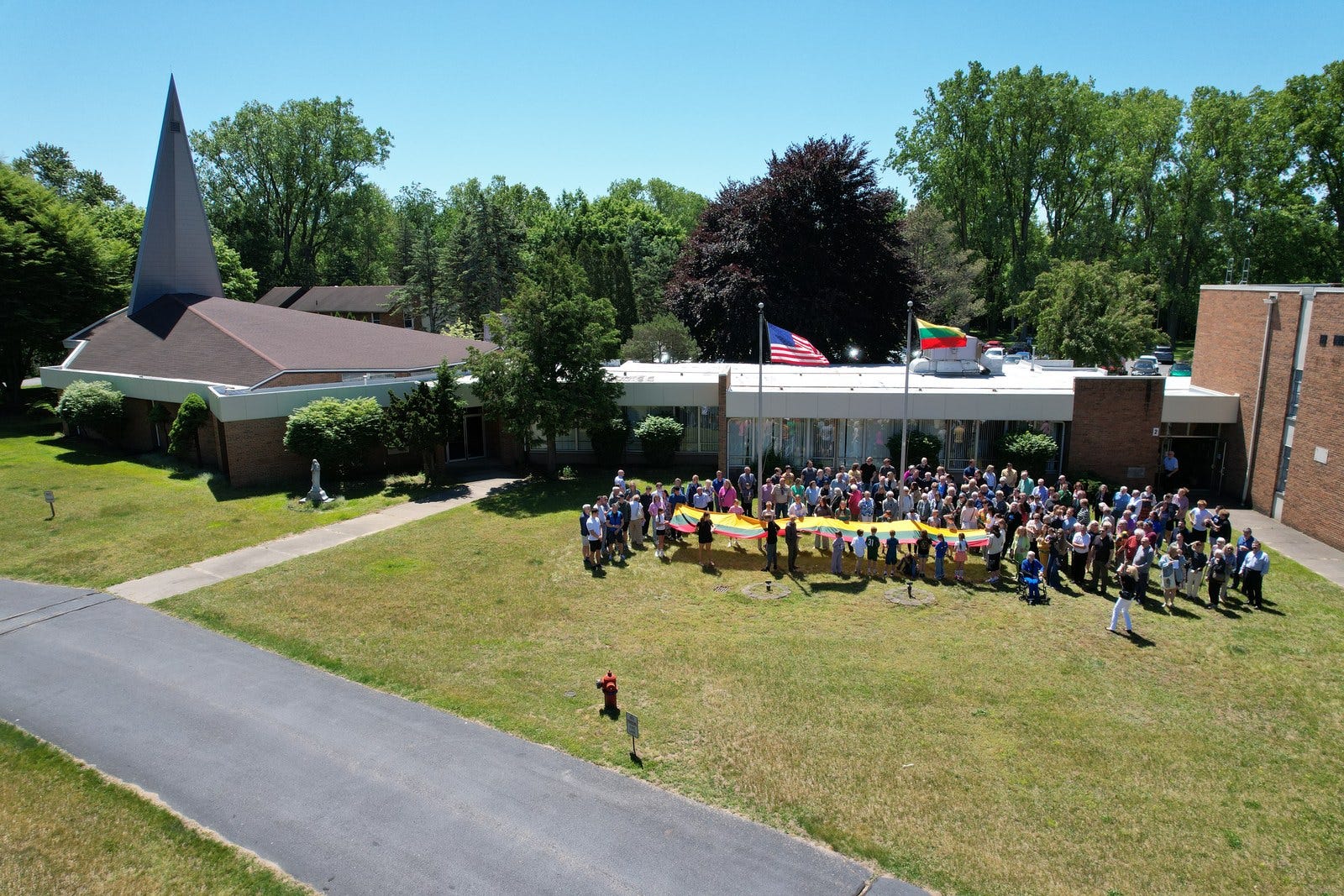
Vilija Jurgutienė, principal, “Žiburys” Lithuanian School, Divine Providence Parish, Detroit
Over the past eighteen years, Lithuanian parishes across America have closed one after another — fifty-five of them. Draugas wrote about each one separately. And we mourned each one separately — an old church, a shrinking community, tired people. A different city, a different year, a different parish. Taken one at a time, each closing looked like a separate misfortune with its own separate cause.
But those closings can be read another way — all of them together, as one long record. That record now exists. The entire Draugas archive since 2008 has been read straight through, and every American Lithuanian parish mentioned in it has been entered into the same record — eighty-three of them. Gathered into one place, the closings stop looking like isolated events.
Out of them, one truth emerges. What decides a parish’s fate is not faith, not money, not the number of people, and not even how bravely the community fought for it. One thing decides it — whose hands hold the parish’s deed.
In Whose Name the Deed Stands
“Who does the parish belong to?” Draugas has raised a similar question before. In 2009, at the Third U.S. Lithuanian Catholic Pastoral Conference, the opening lecture was titled “Who does the church belong to?” The question is simple, and for many parishioners the answer was unexpected.
Lithuanians in America built their churches themselves — with their own hands and their own money. But the building and the land almost never belonged to those who built them. They belonged to the diocese.
This is not an accident and not a local mistake. It is a long-established decision of canon law. In 1884, the Plenary Council of Baltimore ruled that parish land and buildings belong to the local diocese, not to the parish itself. Draugas recalled the same point in 2020: “all parish real estate… must belong to the local dioceses, not to the parish.” This rule applied equally to all parishes — to those a community built and maintained with its own funds, and to all the rest. It remains in force today. And it is the root of this whole history.
What that means in everyday life was explained to Draugas in 2022 by a member of Boston’s St. Peter Parish. The community wanted to secure heritage protection for its church — and could not even do that. “We can’t even do that,” she said, “because the owners of this church are not us, but the archdiocese.”
That is why the separate closings form a single record. Of the 83 parishes gathered, 55 were closed by diocesan decision — some demolished, some merged with others. And all 55, without exception, were diocese-owned Roman Catholic parishes. This happened in various states and various dioceses — in Pennsylvania, in New England, in the Midwest. The cities differed, the decades differed, the bishops differed. The result was the same everywhere. Across eighteen years and all those closings — not a single exception.
The community built it. The community maintained it. But the diocese held the deed. And when the diocese holds the deed, the one who decides is not the one who built.
Money, Loyalty, a Fight — and Closed Anyway
One might think money saves a parish. The record shows otherwise. St. Casimir Parish in Worcester, Massachusetts, had just finished nearly a million dollars’ worth of repairs and carried no debt at the time of its closing. St. George Church in Shenandoah had accumulated about a million dollars and had more than a thousand donors. The parishioners of Our Lady of the Gate of Dawn in New York offered to pay for the church roof repairs themselves. All of these parishes were closed or demolished.
The Shenandoah case shows how the “repair” justification actually works. An engineer hired by the parish itself estimated the repairs at roughly a third of a million dollars. The diocese did not accept that figure, hired its own experts — and in the reports the cost rose to several million, then to nine. The number used to justify closing a church is not set by the community. It is set by whoever holds the deed. And the million dollars the Shenandoah parish had saved was taken by the diocese after the closing.
The same method repeats elsewhere. After a fire or minor damage, the diocese often refuses to repair the building — and then “too expensive to fix” becomes the reason for closing. That is what happened to the Lithuanian parishes in Newark and Elizabeth, New Jersey.
One might think a fight saves a parish. But fighting was not enough either. Communities gathered signatures — one New York petition was signed by nearly four thousand people. They appealed to civil courts and to the Vatican. Even Lithuania’s presidents spoke up for the Lithuanian parishes — both Valdas Adamkus and Gitanas Nausėda. Churches were entered into state heritage registers — but even a registered church would be demolished. Even the 2002 U.S.–Lithuania heritage agreement proved powerless in these cases. Not one of these steps reversed a single closing.
This is seen most clearly in the New York Gate of Dawn case. The parishioners found a legal basis and delayed the demolition of the church for about four years. But in 2011 New York’s highest court ruled that the will of the Church hierarchy outweighs the will of the community itself. The court did not decide whether the church was worth closing. It decided only who has the right to make that decision — and the answer was not the community. Draugas summed up the ruling briefly: “This court decision is final and cannot be contested.” The church was sold to a construction company for tens of millions of dollars and demolished.
These parishes had both faith and loyalty. St. George’s in Shenandoah was supported by more than a thousand donors. Boston’s St. Peter Parish was sustained by Lithuanians since 1898. The people did not abandon their churches. The communities did everything within their power. And still it was not enough, because one thing was never in their hands — ownership itself.
Surviving Once Is Not Yet Safety
Sometimes a parish withstands a restructuring. But the record shows what such survival really means.
Seven Lithuanian parishes survived one wave of restructuring — and then another reached them. Detroit’s St. Anthony Parish escaped closing in 1989, when Cardinal Edmund Szoka decided to rebuild it after a fire. Closed in 2013. Omaha’s St. Anthony Parish weathered the danger around 2008. Closed in 2014. Waterbury’s St. Joseph Parish withstood a 2002 merger and had even begun a real renewal. Closed in 2023. The same befell Philadelphia’s St. Casimir, Philadelphia’s St. George, and New Britain’s St. Andrew parishes — closed or having lost their Lithuanian character. And Maspeth’s Transfiguration Parish, which withstood a 2019 merger, received its closing letter in 2025. Its fate is still being decided.
Each of those parishes survived differently — one saved by a post-fire decision to rebuild, another by a sympathetic clergyman’s intervention, a third by a successfully resisted merger. But none of those rescues was final.
In a parish that remains in the diocese’s hands, two clocks are ticking. One is the community’s: people age, the young move away, fewer faces at Sunday Mass. The other is the diocese’s: review after review, restructuring after restructuring. The community can slow its own clock — welcome new families, educate the children, renovate the church. It cannot stop the diocese’s clock.
There are also parishes that withstood not one review but two or three. But they too remain inside the diocese. As long as the diocese holds the deed, every new review will, sooner or later, reach them as well.
And the two clocks are unequal. The community must win every time. The diocese needs to win only once, because the review always comes back. To survive one restructuring is to win time. But time is not yet safety.
The Only Ones No One Closed
Within the whole record there are also parishes that no bishop closed. They show the same truth from the other side.
This is seen most clearly in Pennsylvania’s coal country. According to Draugas, 31 Lithuanian parishes once operated there. Twenty-nine of them were Roman Catholic, and today all of them are closed. What survived was Scranton’s Divine Providence church. It survived because from the very beginning it was an independent parish — governed not by a Roman Catholic diocese but by the community itself. No bishop can close it, because it belongs to no bishop.
Scranton also shows where that difference came from. Early in the last century, when it became clear that the community that had built a church did not govern it, some Pennsylvania Lithuanians did what the Poles had done a little earlier — they separated from Rome. In 1914 they founded their own Church, the Lithuanian National Catholic Church. In faith and rites it is Catholic, but it does not recognize the authority of the pope and does not belong to the Roman Catholic Church. Its parishes belong to the parishioners themselves.
That difference can be seen in Scranton, in two churches side by side. The Lithuanians there first built a Roman Catholic church; the diocese took it over through the courts. Then some of the Lithuanians withdrew and built their own alongside it — one that no bishop could close or sell. One church today is closed. The other still stands. In 2017 Draugas wrote: “And the ‘independent’ Lithuanian Catholics… still gather every Sunday in their own church.”
That difference can also be seen through one city, in one year. In 2002, in Lawrence, Massachusetts, two Lithuanian parishes came to an end. The Roman Catholic church was closed by the archdiocese, which took its property. The independent parish was closed by the community itself — by its own decision — and it kept the money it received for its own cemetery. The same city, the same year, the same shrinking community. The only difference was in whose hands the decision lay.
Montreal shows the same. Quebec law establishes that the owner of a church is the parish itself, not the diocese. Both of Montreal’s Lithuanian parishes survived.
The difference is shown even by an example unrelated to Catholics. The Lithuanian Lutheran “Tėviškė” parish bought its church in 1957 and has made every decision about it itself ever since. What decides is not the community’s faith. What decides is who governs the building.
Everywhere a parish survived for the long term, the same feature repeats. The church was governed not by the diocese but by the community itself.
Detroit — a Step No One Has Yet Taken
Detroit’s Divine Providence Parish has not yet received a closing letter. It is not being closed. It has been included in the Detroit Archdiocese’s current restructuring. In March 2026 the archdiocese prepared a separate restructuring book for each parish. This matters, because the record shows a clear line. After the closing letter, no parish inside a diocese ever saved itself — not with money, not with courts, not with a fight. The only window that ever decided anything is the window before that letter. Detroit today is still in that window. And it matters for one more reason — Divine Providence is the last Lithuanian Catholic parish in the city. The others are already closed.
The record also shows what that window means. Through it, one can still do the only thing that truly protects a parish — move the deed into the community’s hands.
The Lithuanians of Scranton and Lawrence reached that point their own way: a century ago they separated from Rome and founded a separate Church. But that is their history, not this article’s proposal. What is discussed here is not how to leave the Catholic Church, but how a Catholic parish can hold its own home itself.
A question remains that the record cannot yet answer: whether a parish can stay in the Catholic Church and at the same time hold the deed itself. The record also shows where the limits lie. Seven Lithuanian parishes withstood one wave of restructuring — then another reached them. Only a few restructurings can be withstood.
One of the answers the record raises is to buy the church building back from the diocese. In all eighteen years, not one Lithuanian Roman Catholic parish did so. The idea was raised only once — in 2008, when the Lithuanian Foundation offered to lend parishes money to buy back their buildings. No one carried the offer out. A buyback is possible only when the owner holding the deed agrees to sell, and for a diocese that is itself shrinking and has its own financial troubles, selling a half-empty church in a good location to a construction company is often more profitable than selling it to the Lithuanian community. This is not malice — it is simple property arithmetic.
But what has not yet appeared in the record can still appear in it. Detroit’s Divine Providence Parish is today still in the window before the closing letter. It still has what it will not have later — time. Time to ask, time to learn from history, time to decide together.
While the Community Still Decides
Eighty-three parishes. Fifty-five closings. Eighteen years. The whole record says one thing: a parish’s fate was decided not by faith, not by money, not by the number of people, not by the courage of the fight. It was decided by ownership. The parishes governed by the community itself survived. The parishes governed by the diocese were, sooner or later, closed.
That 2009 lecture raised three examples of hope. The property of Brockton’s St. Casimir Parish passed not to the diocese but to a Lithuanian mission. Manhattan’s Gate of Dawn parishioners were weighing whether they could legally reopen the church. A court in Spokane had ruled that the bishop is merely the custodian of church property, not its owner. Seventeen years later, all three ended the same way. The Brockton Lithuanian community dispersed. Manhattan’s Gate of Dawn was handed to the diocese by the court in 2011 — the church demolished. In Spokane, legal hope saved not a single Lithuanian parish.
This is not a sad story about what is inevitable. It is knowledge of what can still be done while it is not too late. Divine Providence Parish is still alive. The Lithuanian language still sounds in it; the Lithuanian school, the choir, the archive, the dance ensembles, the scout troops, the ateitininkai, the Kovas sports club, the Lithuanian Daughters, the Lithuanian Community all still operate there. And while the closing letter has not yet come, the decision is still held by the community itself.
In 2025, in Draugas, Lithuania’s Consul General in New York, Dovydas Špokauskas, said something simple: “what is built by Lithuanians must, legally, remain with Lithuanians.” The churches built by Lithuanian hands already belong to Lithuanians — through labor, sacrifice, memory. By the deed — not yet.
The community must hear the question “Who does the parish belong to?” as addressed to itself. And answer it itself — while it still can answer itself.
This article is the first of several. It raised the question of what decides a parish’s fate: who holds the deed. The articles that follow will ask what the parish means to its community and how to keep it alive.