
The Boston Hill of Crosses: How South Boston Saved Its Lithuanian Parish
In 2004, the Archdiocese of Boston moved to close 82 of its 357 parishes. St. Peter Lithuanian in South Boston was one of them. This is how a few hundred people saved it.

The notices came at the end of May 2004. The Archdiocese of Boston’s reconfiguration plan slated 82 of its 357 parishes to close — nearly one in four. On May 25, word reached St. Peter Lithuanian Church in South Boston: Archbishop Seán P. O’Malley intended to close its church and school. St. Peter’s had been the spiritual and cultural center of the city’s Lithuanian community for a century — its parish rooted in the 1890s, its church dating to 1904.
In the end, some 60 of those churches were lost. St. Peter’s was not. It is still open, still holds a Lithuanian Sunday Mass, and in October 2024 it celebrated the 120th anniversary of its church. The difference between the parishes that closed and this one comes down to what this community did in the months after that notice arrived.
What they did
They did not wait, and they did not simply grieve. By June 1, an appeal was underway — they used the church’s own formal process, not protest alone. On June 13, hundreds of parishioners surrounded the church and founded a supporters’ movement, the rėmėjai, the Friends of St. Peter Lithuanian Parish. Roughly 600 people joined on the first day. That gave the community something loose outrage never provides: a single organized body, with a name and standing, that the archdiocese would have to deal with directly.
On September 12, some 400 of the faithful gathered for the church’s centennial Mass wearing protest pins — a hundred years, almost to the season, since the church was consecrated, now marked under threat of closure.
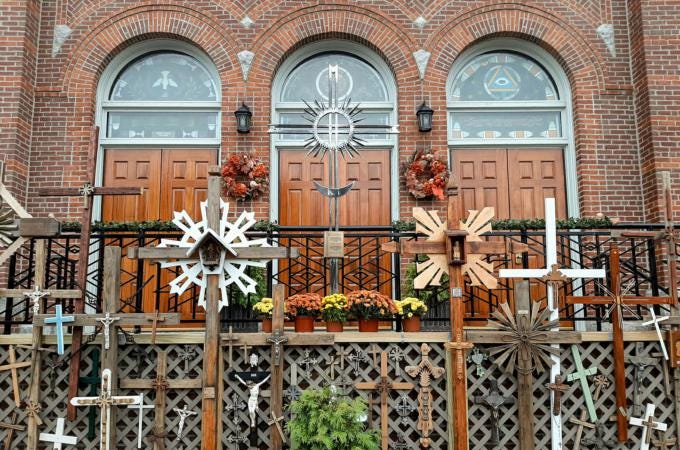
Then, on October 31, 2004, after a Vėlinės — All Souls’ — Mass, they built a hill. Parishioners set wooden crosses into the ground in front of the church steps and tied them to the stair railings; many had been made by children from the parish’s Lithuanian school. A Lithuanian newspaper ran the headline that said exactly what they meant by it: „Parapijiečiai stato ‚Kryžių kalną’ bažnyčiai gelbėti“ — Parishioners build a “Hill of Crosses” to save their church.
They were invoking the real one. Outside Šiauliai in northern Lithuania stands the original Kryžių kalnas, the Hill of Crosses, which grew after the failed uprisings against Russian rule in 1831 and 1863 and became, under Soviet occupation, a place the regime could not erase — bulldozed flat three times, guarded, and rebuilt each time overnight, until it held more than a hundred thousand crosses. To plant crosses before a church slated for closure is to say, in the oldest language the nation has, you can flatten this and we will build it again. It turned an internal parish dispute into a story the wider public could see and understand.
What it won — and what it cost
It worked. Thirteen months after the notice, in the summer of 2005, the archdiocese — on the recommendation of a reconfiguration committee made up mostly of laypeople — agreed that no closure date for St. Peter’s would be set, indefinitely. The parish’s own pastor, kun. Steponas Žukas, laid out the reprieve in Draugas that July. It held. It has held ever since.
But survival did not mean everything stayed the same, and this is the honest part of the lesson. In 2015, St. Peter’s was folded into a collaborative under the archdiocese’s “Disciples in Mission” plan — its administration and clergy pooled with neighboring parishes. It got a shared collaborative pastor, Fr. Stephen Madden, and a vicar, Fr. Gerald Souza. Its own long-serving priest, kun. Steponas Žukas, left on June 2, 2015, after sixteen and a half years, recognized by the archdiocese as chaplain to the Lithuanian apostolate. The community could not keep full independence or its own resident pastor. What it did keep was the church building, the Lithuanian Sunday Mass, and formal recognition of its Lithuanian mission. It defended what was essential and let go of what wasn’t — and it did not make the common mistake of treating a reorganization as a death.
The crosses stayed. On October 27, 2019, fifteen years after the first ones went into the ground, the parish rededicated the monument; a Lithuanian priest, Fr. Aurelijus Gricius, blessed it, and the Friends of St. Peter commissioned a new metal cross. What had begun as a barricade had become, in the words of the archdiocese’s own newspaper, “a monument to the persistence and faith of the archdiocese’s small but proud Lithuanian community.”
What worked
On October 20, 2024, St. Peter’s marked the 120th anniversary of its church with a jubilee Mass that ended on two words needing no translation: „Parapija gyvuoja!“ — The parish lives.
Pull the story apart and the same few things carried it, and any community facing the same letter can use them:
They organized fast and formally — a named body within days, not a scattered crowd, so the archdiocese had a real counterpart to negotiate with, and a lay committee whose recommendation ultimately won the reprieve.
They fought on two tracks at once — filing the official appeal and making a public case. Either alone is weaker than both together.
They built a symbol that carried meaning — the Hill of Crosses gave the fight a face anyone could grasp and rooted it in a heritage no one could argue away.
They made closure a real loss — not the shutting of one more church, but the erasure of the last home of a distinct community, its language, and its school.
And they knew the difference between losing and dying — when restructuring came, they protected the essentials and accepted the rest, instead of walking themselves into the grave over a shared pastor.
There is still a Lithuanian Mass in South Boston, and there is still a hill of crosses on West Fifth Street — because a few hundred people decided their church was worth fighting for, and fought for it the right way.
Sources
The scale of the 2004 closures. The reconfiguration plan slated 82 of the archdiocese’s 357 parishes to close (Draugas, Sept. 28, 2004, p. 4); roughly 60 churches were ultimately lost (The Boston Pilot, “Archdiocese to lose 60 churches,” May 28, 2004). St. Peter’s received its notice on May 25, 2004.
Primary coverage — Draugas (verified per-issue links):
External corroboration:
St. Peter Lithuanian Parish (official site): https://www.stpeterlithuanianparish.org/
Hill of Crosses (Kryžių kalnas) — Wikipedia: https://en.wikipedia.org/wiki/Hill_of_Crosses