
In Writing: The 1968 Letter That Made Divine Providence a National Parish
In 1968 the Archdiocese of Detroit formally established Divine Providence as a national parish under canon law — only Lithuanians could join, and Lithuanians would fund it. Here is the letter, and the story behind it.

Whenever anyone asks whether Divine Providence is “really” a Lithuanian parish or just a church that happens to have Lithuanians in it, there is a document that settles the question. On December 31, 1968, the Archdiocese of Detroit put it in writing.
The Archdiocese of Detroit formally established Divine Providence as a national parish under canon law — a deliberate decision, with a promise attached. It was a canonical status the community asked for and the Archbishop granted, in writing.
A parish that had to move — twice
Divine Providence traces its roots to St. George, founded by Detroit’s Lithuanian Catholics in 1908. Twice in the twentieth century the community lost its church to Detroit’s highway construction, and twice it rebuilt. By the late 1960s it faced a third move — and its leaders decided that if they were going to build again, they would secure, once and for all, the parish’s standing as a Lithuanian parish, not tied to any neighborhood.
The request (1967)
On August 18, 1967, the parish committee formalized its request and sent it to the Detroit chancery. In their own words — preserved, original spelling and all, in the parish’s 1973 anniversary book — they asked:
“We request that our church be legally called Lithuanian, with the canonical and ecclesiastical status, title, rights and privileges of a Lithuanian Roman Catholic Church, as now enjoyed by the Divine Providence Lithuanian R. Catholic Church, with no territorial boundaries for the Lithuanians.”
They were not asking for a favor. They were asking the Archdiocese to recognize, in canon law, what the community already was: a parish of a people, gathered from across the region, not a parish of a place.
The meeting (December 2, 1968)
On December 2, 1968, a large gathering of parishioners met with the newly consecrated auxiliary bishop of Detroit, Thomas J. Gumbleton — ordained that May by Archbishop John Dearden — at the invitation of the pastor, Fr. Michael Kundrat (Mykolas Kundrotas). The parish’s account is candid: the bishop began by trying to persuade them to accept an ordinary territorial parish and give up Lithuanian status. The younger generation and the Knights of Lithuania answered him with careful arguments for a non-territorial Lithuanian parish. The committee chair, Antanas Dainius, called for a vote. It was unanimous. Closing the meeting, the bishop said simply:
“It will be as you wish.”
The letter (December 31, 1968)
Weeks later, the promise arrived on Archdiocese of Detroit letterhead, from the Office of the Vicar for Parishes and initialed T.J.G. It reads, in the paragraph that matters most:
“He has agreed with the selection of the site at Beech Daly and Nine Mile Road. He also has accepted the decision of the parishioners to make this parish a national parish, with the rights and limitations that are canonically imposed on such a parish. In effect this means that only people of Lithuanian Nationality can become registered parishioners, and the support of the parish must be provided by them.”
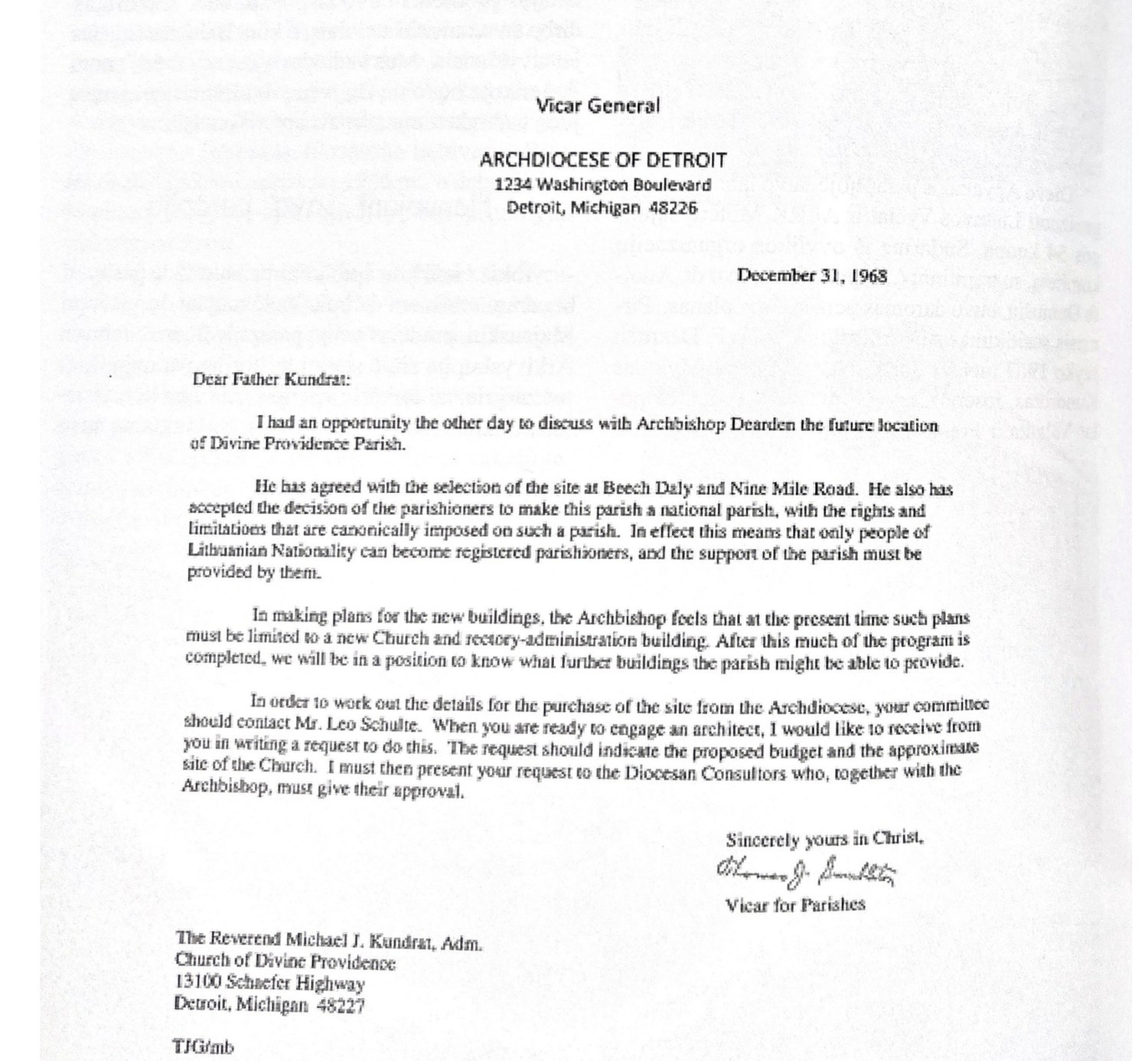
Read that again. This is the Archdiocese of Detroit, on behalf of Archbishop Dearden, invoking canon law by name — “the rights and limitations that are canonically imposed on such a parish” — and setting out the exact terms: only Lithuanians may register, and the Lithuanians themselves must fund it. That is not an informal ethnic flavor. That is a national parish, established by decision of the Archbishop and put in writing.
They kept their word
The community met every condition the letter named. Lithuanians funded the parish themselves and built it with their own hands — church, rectory, and cultural center — consecrating the new church in Southfield on September 8, 1973, the same year the Soviet regime was bulldozing the Hill of Crosses in occupied Lithuania. The one obligation the Archdiocese attached in 1968 — “the support of the parish must be provided by them” — has been honored for more than half a century. To this day, Divine Providence carries zero debt and funds itself.
Why this is different
Every argument in this publication about metrics and yardsticks rests, in the end, on this letter. Divine Providence is a personal (national) parish under canon law — a category the Church’s own law provides for, defined by a people rather than a territory. The Archdiocese did not stumble into that status; it granted it, deliberately, in writing, in 1968.
Which means that measuring Divine Providence today by territorial metrics — the size of the surrounding neighborhood, whether another church sits nearby, how the local population has shifted — is not just the wrong test. It contradicts the Archdiocese’s own written decision that this parish would never be territorial in the first place. And the single condition attached to that decision, that the community fund itself, has been kept in full.
A promise was made, in writing, by the Archbishop’s own office. The community has kept its half for fifty-seven years. The only open question is whether the Archdiocese will keep its own word.
Sources
The 1968 letter shown here is from the Office of the Vicar for Parishes, Archdiocese of Detroit, to Fr. Michael J. Kundrat, Administrator, Church of Divine Providence, dated December 31, 1968 (from the parish’s archives). The account of the 1967 request and the December 2, 1968 meeting, including the request text and Bishop Gumbleton’s words, is drawn from the parish’s anniversary book,
Dievo Apvaizdos Parapija 1908–1973 (Divine Providence Parish, 1908–1973), pp. 48–51.
On Bishop Thomas J. Gumbleton (consecrated auxiliary bishop of Detroit, May 1, 1968, by Archbishop John Dearden) — Wikipedia; Archdiocese of Detroit.
On personal/national parishes in canon law (Canon 518) — see our companion post, “A Personal Parish, Not a Place.”
A note on the request text: the 1967 wording is reproduced from the parish anniversary book; obvious typographical errors in the original have been silently corrected, but no words have been changed.