
Closed, Not Ended: The Vatican Appeal for Šv. Juozapo (St. Joseph's) in Waterbury
New England's first Lithuanian parish closed September 30, 2023, with a Vatican appeal mounted in its final weeks. Almost three years later, the church is still standing, still Catholic, not sold.

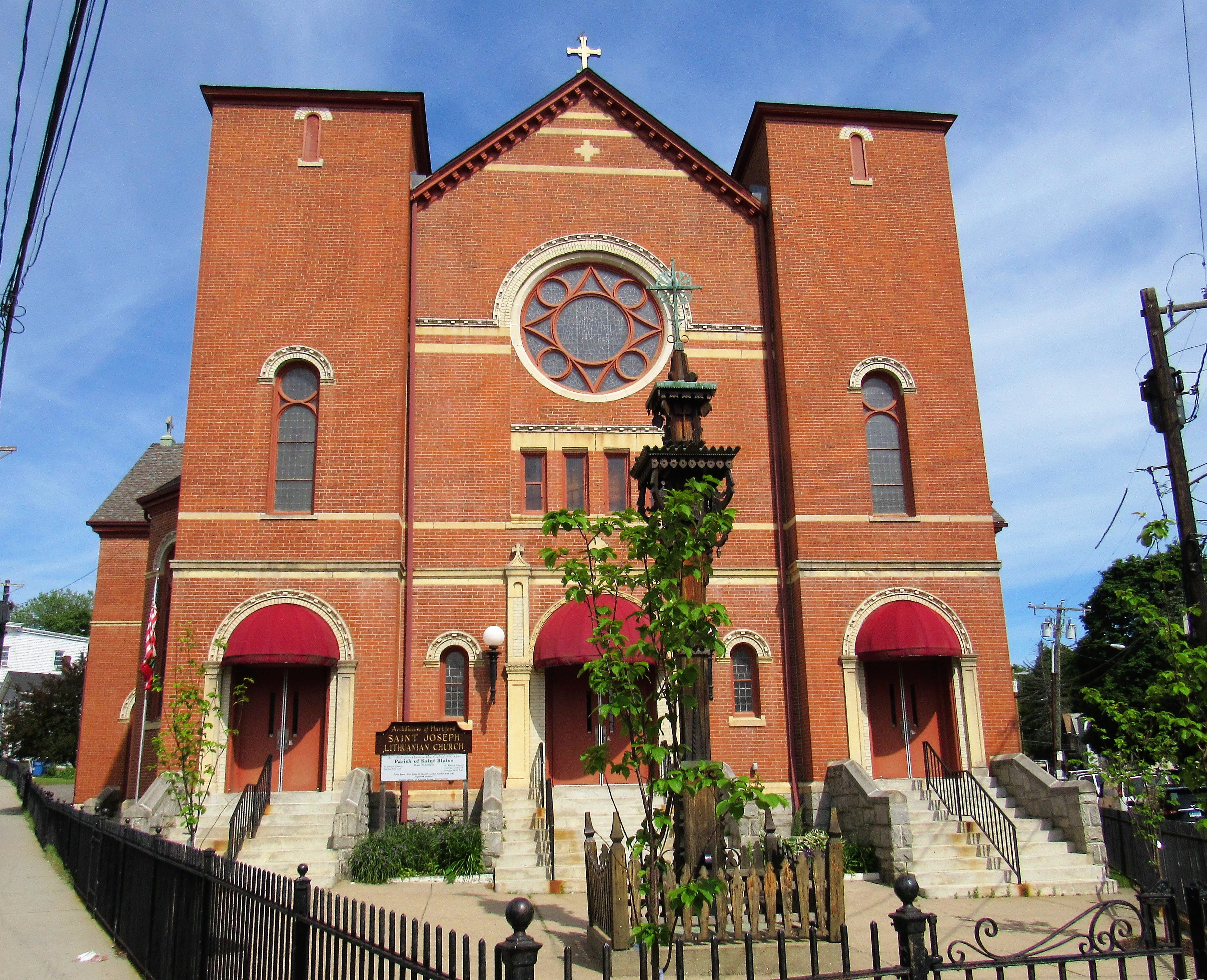
The record starts early in Waterbury. The parish was founded in 1893 — the first Lithuanian Roman Catholic parish in New England — and the first Lithuanian Mass in Connecticut was celebrated the following year, in a house not far from where the church now stands. The brick church at 46 Congress Avenue went up in 1904 and 1905, the oldest Lithuanian church in the state. The heritage survey that mapped these buildings notes what the parish chose and what it declined: two Baroque Revival towers were planned that would have made it, in the survey’s words, the most impressive Lithuanian church in Connecticut — and the community built a massive Lithuanian school instead. A traditional wooden chapel-post still stands in front of the church. Inside are stained-glass windows with Lithuanian inscriptions the survey ranks among the most impressive of any East Coast Lithuanian church. At its peak, the survey counts some 10,000 Lithuanians in the Waterbury area, 6,000 of them members of this parish; Waterbury remains the most Lithuanian city in Connecticut.
The Lithuanian daily Draugas first mentions the parish on September 30, 1909, and returns to it 93 times across the following century. The parish’s last day was September 30, 2023 — one hundred and fourteen years, to the day, after it entered the paper of record.
What the record shows
Summer 2023. The parish had survived before — it came through the 2002 St. Patrick’s merger, and the record notes a genuine grassroots revival in its final years. But under the Archdiocese of Hartford’s restructuring plan, the closure notice came suddenly, with weeks, not years, to respond — “working against the clock,” as parishioner Christian Allyn put it to WFSB that August, calling the announcement “a very sudden shock.” The reasons came in the archbishop’s letter to parishioners: a decrease in parishioners, and a lack of priests — Waterbury “was for a very long time ‘fruitful ground’ for vocations to the priesthood. That, sadly, is no longer the case.” Thirty to forty people were attending the weekly Mass. Lifelong parishioner Mary Gluodenis stood by the church she had known since childhood: “I remember coming to grade school here walking past that statue.”
Late summer 2023. With the closure set for the end of September, Allyn — working with a canon lawyer and members of the Knights of Lithuania Council 7 — mounted an appeal to the Vatican against the suppression. The archdiocese, for its part, said it planned to sell off the property. The appeal was in motion before the parish’s last day; that timing is the entire story.
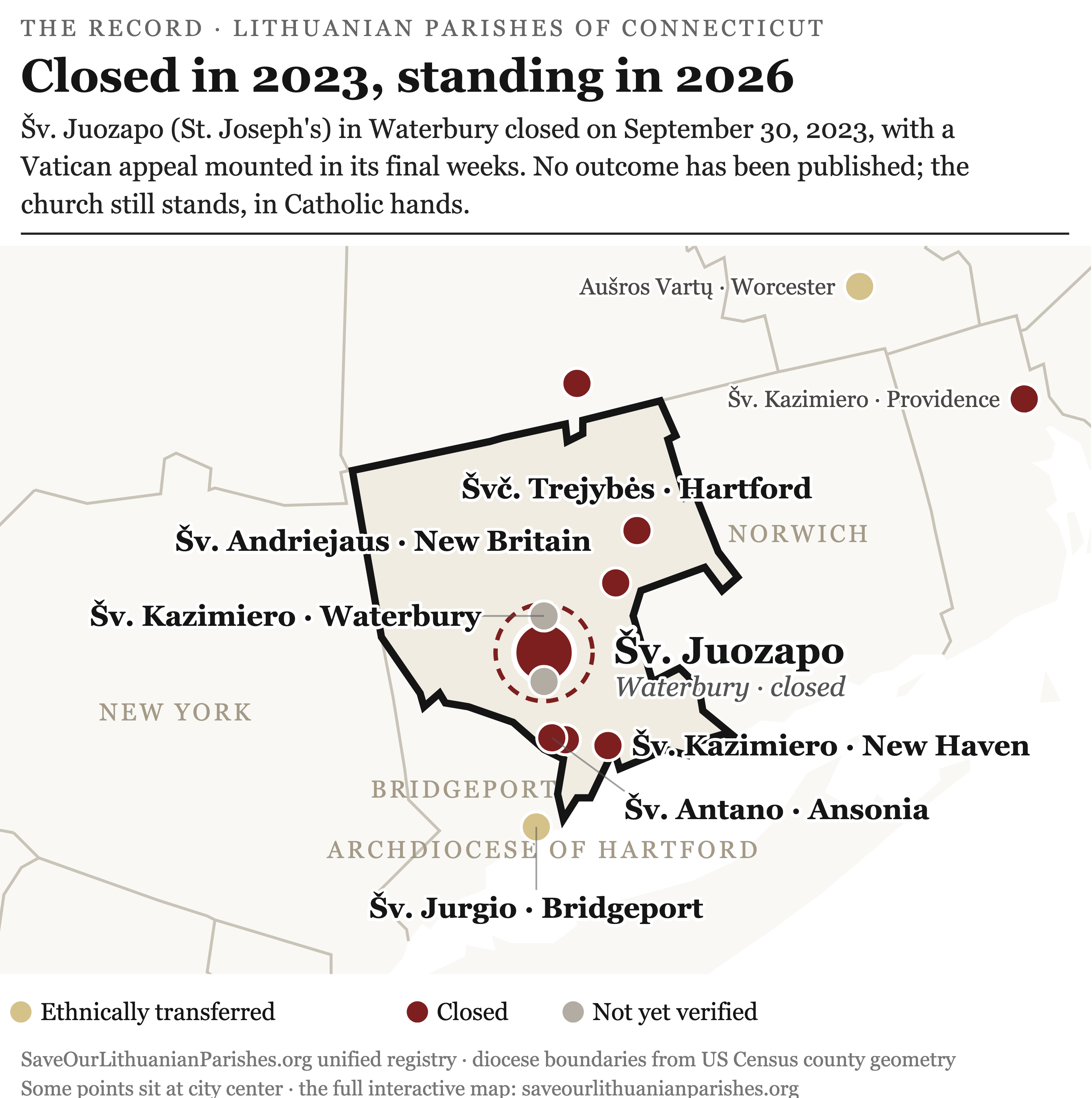
September 30, 2023. The parish closed by decree and was absorbed into Our Lady of Mount Carmel Parish. In the record, Šv. Juozapo stands Closed.
Since then — the part worth studying. Nearly three years on, no outcome of the Vatican appeal has been published. And while the appeal waits, the church still stands: not sold, not demolished, in Catholic hands, listed by the merged parish as open for weddings and funerals through the parish office. In October 2025, the City of Waterbury posted a request for proposals to sell the former parish campus on John Street — the school building, the former convent, the garage, the club building — and the listing explicitly excluded the church building and its lot from the sale. Whether the pending appeal shaped that exclusion, the record cannot say. What the record can say is this: the parish that filed its appeal in time still has a church, and the record’s own assessment of the campaign reads, “the community has so far prevented a complete ending.”
What it means
The record now holds the three states of the fight, side by side. Maspeth, the first dispatch, shows the window open: a community organizing before any decision, and a diocese stopping short of closing. Hartford, the second, shows the window closing: fifteen months from printed assurance to the end of Masses, with no appeal filed in time. Waterbury shows what comes after the window closes — if, and only if, someone acted inside it. An appeal mounted in the parish’s final weeks has now outlasted the closure by almost three years. The building the archdiocese once said it planned to sell is the one building on the block excluded from sale — the record holds those two facts side by side and claims no connection between them. The documented reversals in the American record — Cleveland’s reopened churches among them — were won by exactly this method: not quickly, but by getting into the Church’s own process before it finished, and staying there. Waterbury’s outcome is not yet written; its method is the proven one.
The cost of staying there has a number. The GoFundMe for the canonical fight shows expenses already paid of $9,912.70 — canon attorney’s fees, a commercial property appraisal, the scanning of the parish’s historical documents — against $2,400 raised toward a $15,000 goal. The page states plainly that these expenses “have already been accrued and paid by Christian Allyn”: one parishioner has fronted a canonical case from his own pocket. And the playbook is moving in real time — Hartford’s campaign, opened this May by the same organizer, names Waterbury as its model: “The Waterbury Lithuanian community has already retained a Canon attorney and has been successful in so far preventing the complete closure of St. Joseph’s Church.”
What you can do today
Fund the fight that is already working. The Waterbury appeal has run on one family’s savings: $2,400 raised of $15,000, against nearly $10,000 already spent. The GoFundMe is here.
Hear the story told. The Final Service, a podcast on America’s closing churches, devoted an episode to this fight in April 2025 — “Little Lithuania,” thirty-two minutes on what one parishioner and a canon lawyer can do.
Send what you hold. Bulletins, photographs, sacramental records, school memorabilia — Šv. Juozapo’s record is still being assembled, and preservation cases stand on records. The parish’s page is here; documents and corrections go through saveourlithuanianparishes.org/report.
If your parish is still open, learn the one lesson Waterbury teaches. The appeal that holds was the appeal filed in time. Start at saveourlithuanianparishes.org/start-here. Every active campaign is tracked at /under-threat.
Three signals will tell where Waterbury is heading: word from Rome on the appeal, in either direction; what the merged parish and the archdiocese decide about the church building itself; and the outcome of the John Street campus sale. The record will carry each as it comes.
Sources
The closure and the appeal: Parishioners fight Waterbury church closure — WFSB, Aug. 28, 2023
The campaign: Save St. Joseph’s Lithuanian Catholic Church — GoFundMe, opened Sept. 7, 2023 · Protect Holy Trinity Church — GoFundMe (Hartford, citing the Waterbury model)
The campus sale: Purchase and Sale of Former St. Joseph Parish Corp. Properties, RFP 8610-Wtby — City of Waterbury listing, Oct. 2025
The story in audio: The Final Service — “Little Lithuania,” April 2025
The Lithuanian press of record: Draugas — the Lithuanian daily, published since 1909: Sept. 30, 1909 (the parish’s first appearance — open archive)
The heritage record: Connecticut — Global True Lithuania (heritage survey: 1894 first Mass; 1904–05 construction; the unbuilt towers and the school; the windows)
The record: The parish’s case record · Documented US closure reversals